





Table of Contents
9 Insights that changed how I think about Retail CX.
Last summer, I had my first child, and whilst I knew maternity leave would be transformative personally, I didn’t expect it to shape some customer experience lessons I’d carry forward in my career.
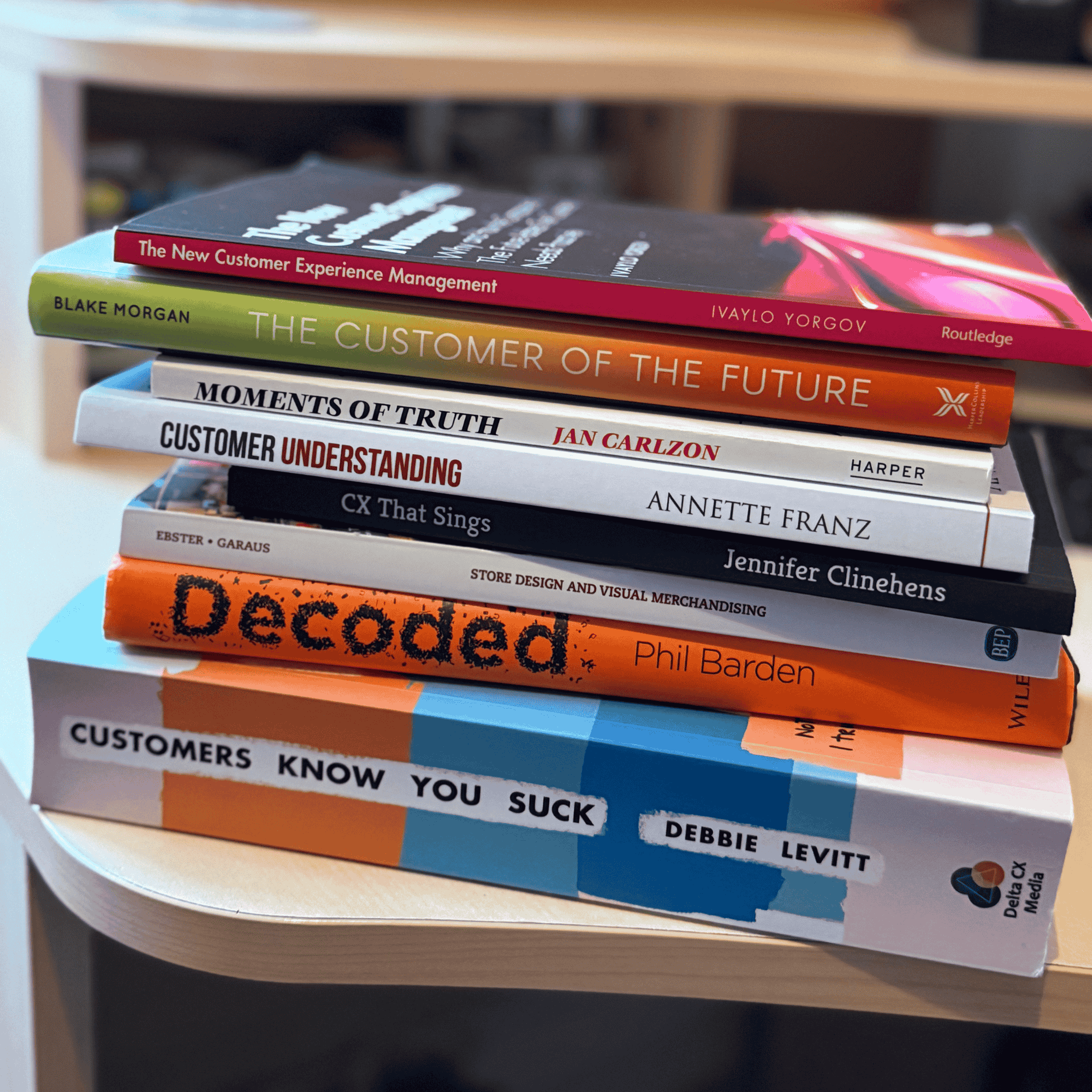
The first few months were foggy – feeding, nappies, trying to remember if I’d had breakfast. But somewhere around month six, my brain started working again. I found pockets of time between feeds, and instead of the thrillers I usually read, I turned to books about customer experience. Nine of them, actually.
What struck me wasn’t just the individual insights, but the patterns emerging between them. Customer experience lessons that most of us know but struggle to put into practice. So I thought I’d share what surfaced during those stolen moments of reading – not as a definitive guide, but as observations that might resonate with where you are right now.
What This Episode Covers
I walk through nine customer experience lessons that emerged from my reading and learning this year. Some challenged assumptions I’d held for years. Others confirmed suspicions I’d been too busy to examine properly.
These aren’t theoretical concepts. They’re patterns I noticed across multiple thought leaders, tested against my own experience in retail, and reinforced by what I observed as a customer during this unusual year.
Customer Experience Lessons That Emerged From Nine Books
Lesson 1: Reactive Customer Experience Is Already Too Late
This first customer experience lesson comes from Ivaylo Yorgov’s work on predictive customer experience, and it’s this: if you’re waiting for customers to tell you there’s a problem, you’ve already failed them.
Most businesses still operate in reactive mode, waiting for customers to complain before taking action. But here’s the reality: the companies winning on customer experience aren’t the ones with the best recovery strategies – they’re the ones preventing problems before customers even know they exist.
Think about it: for every customer who bothers telling you about a problem, dozens of others are simply taking their business elsewhere. Research shows that 93% of customers are likely to make repeat purchases with companies that provide excellent customer service (Radius Global Solutions, 2025).
The retailers that truly stand out are tracking delivery patterns to communicate delays proactively, monitoring website behaviour to fix friction points before customers abandon their baskets, and anticipating when customers might need birthday gift ideas.
We can all blame old systems and a lack of data integration. But this isn’t about having perfect systems – it’s about building intelligence into your operations so you can act before problems become customer problems.
What signals are your customers already sending that you’re not listening to or watching?
Lesson 2: Culture Beats Strategy Every Time
This customer experience lesson comes from both Blake Morgan and Jan Carlson’s work, and it’s a truth that many leaders don’t want to hear – and one that’s easy to forget as well.
Your culture determines your customer experience, not your strategy. You can have the most beautiful customer journey maps, the most detailed customer service standards, and the most expensive CX technology. But if your people don’t feel trusted to do the right thing for customers, none of that matters.
You see this all the time – retailers with elaborate training programmes, but staff who aren’t allowed to check the stock room without manager approval. Returns processes that don’t allow teams to accept products from other store locations. Companies that talk about customer centricity, whilst their employees feel undervalued and disempowered.
Carlson saw this during his role at SAS: every customer interaction is a moment of truth, and the people delivering those moments need the authority to make them positive. When employees feel trusted and empowered, they create experiences that no script or process could ever deliver.
This is why employee experience isn’t separate from customer experience. It’s the very foundation of it. Do your frontline teams have the power to solve problems in the moment, or are they handcuffed by processes?
Lesson 3: Customer Understanding Requires Discipline, Not Just Data
One of the most challenging customer experience lessons comes from Annette Franz’s work on customer understanding, and it challenges how most businesses think about knowing their customers.
Having customer data isn’t the same as understanding customers. I’ve worked with retailers who have mountains of transactional data, heat maps, and survey responses, but they still can’t answer basic questions about why their customers behave the way they do.
Franz’s three-part framework is deceptively simple but powerful: listen, categorise, and empathise. Most businesses do one or two of these things really well – usually listening through surveys – and then assume that’s good enough. But real customer understanding comes from weaving together what customers tell you, who they are as people, and what it feels like to be in their shoes.
It’s the intersection of feedback, personas, and customer journey mapping that reveals the insights that drive real change.
I recently worked with a retailer who had strong NPS scores but declining customer retention. When we layered in customer personas and interviews, we discovered their returns policy was creating anxiety – not because it was bad necessarily, but because it was complicated and customers couldn’t understand it easily.
Are you just collecting customer data, or are you building customer understanding?
Lesson 4: Customer Journey Maps Are Worthless Without Action
This particular customer experience lesson from Jennifer Kleinhan’s work is painful but true about one of my favourite tools.
I love customer journey mapping – a thorough customer journey map is one of the most powerful assets you can create in a business. But I’ve seen too many beautiful maps that end up as wall art. They capture insights, identify pain points, create alignment, and then nothing happens.
The maps that actually change businesses are different. They’re built with specific decisions in mind. They prioritise opportunities based on customer impact and business feasibility. They become living tools that guide where teams invest their time and resources.
What separates effective customer journey mapping from expensive exercises is clarity about what happens next. Before you start mapping, you need to know what decisions the map will influence and who will act on what it reveals.
What decisions will your customer journey map actually change, and who’s committed to making them?
Lesson 5: Excellence Lives in the Basics
This customer experience lesson from Matt Watkinson’s work is a reality check for anyone chasing the wow moments.
Great customer experience isn’t built on surprise and delight. It’s built on consistency in meeting expectations and removing friction from the basics.
Many businesses obsess over loyalty programmes and personalisation, whilst their website is confusing and difficult to navigate, their checkout process is broken, and their customer service team is significantly understaffed. They’re trying to create magic whilst their foundation is crumbling.
Watkinson’s principles are clear: minimise stress, set and meet expectations, deliver tangible value. These aren’t very exciting, but they are what separates retailers’ customers trust from retailers customers will tolerate.
Where are you chasing innovation instead of fixing the fundamentals that are costing you customers every day?
Lesson 6: Metrics Follow Experience, Not the Other Way Round
One of the most important customer experience lessons comes from Debbie Levitt’s brutally honest take: optimising for scores instead of experiences is exactly why your customer experience isn’t improving.
Too many teams are directed to improve metrics and spend their energy trying to move Net Promoter Score or customer satisfaction scores by a few points, instead of fixing the underlying issues that create those scores.
They try to game the system like timing surveys better, tweaking wording on certain questions, focusing on easy wins – whilst the fundamental experience remains broken. Customers don’t care about your NPS score. They care about whether you make their life easier or harder.
When you fix the experience, the metrics follow. When you chase the metrics, you often make the experience worse.
Are you measuring to understand customer pain, or are you measuring to hit targets?
Lesson 7: Customers Decide With Emotion, Then Justify With Logic
This customer experience lesson from Phil Barden’s work on decision science challenges how most businesses think about customer choice.
Your customers aren’t rational decision makers carefully weighing features and benefits. They’re emotional beings making fast, automatic decisions based on how things feel, then finding logical reasons to support those choices after.
This means brand signals, first impressions, and emotional triggers matter more than detailed feature comparisons. Reducing the cognitive effort involved in shopping is often more powerful than adding functionality.
When customers choose you, they’re not just buying your product or service; they’re buying how it makes them feel about themselves. When they choose someone else, it’s often because your experience created friction, feelings of confusion, or doubt.
What emotional impression does your experience create, and does it align with how customers want to feel?
Lesson 8: Physical Spaces Shape Behaviour
This customer experience lesson comes from research on store design and visual merchandising, and it’s a reminder that your environment is constantly influencing customer behaviour.
Every design choice from lighting to layout, signage to product placement, shapes how customers feel and act. The entrance sets expectations. The flow determines what gets noticed. The atmosphere influences how long people stay.
Customers make judgments about your brand within seconds of entering your space. They decide whether to explore or leave, whether to trust or be sceptical, based on cues they process subconsciously.
Understanding this gives you the power to guide their behaviour intentionally rather than leaving it to chance. An extreme example is the IKEA experience, where you’re literally guided around the whole shop before you can pay or pick up what you came in for. You get their brand experience on the way around.
What story is your physical environment telling, and is it the story you want customers to hear?
Lesson 9: Customer Experience Is Built in Everyday Moments
The final customer experience lesson brings us back to Carlson’s fundamental insight: customer experience lives in the small, everyday interactions that most businesses overlook.
It’s not the big campaigns or clever technology that determine customer loyalty. It’s whether the phone gets answered promptly, whether promises are kept, whether employees seem to care, and whether problems get solved without customers having to chase.
There’s a cheerful lady who works in Card Factory near where we live. I’ve been buying balloons there recently (a christening, a first birthday) and she makes the whole process so easy, engaging me in happy conversation whilst I wait. I just know when I need balloons again, that’s where I’ll go back to.
These moments happen dozens of times a day across your business. When you get them right consistently, customers forgive the odd mistake. When you get them wrong repeatedly, no amount of marketing can save the relationship.
People remember how you make them feel. Which everyday moments are you winning, and which ones are driving customers away?
What Connects These Customer Experience Lessons
What connects all these customer experience lessons is that CX isn’t about tactics or technology, it’s about people. Understanding customers deeply, empowering teams to serve them well, and getting the basics right every time.
Most of us know this, but few of us have the discipline to act on it consistently. We get distracted by the next trend, the latest tool, or the promise of an easy fix.
Successful retailers are committing to the basics, investing in understanding their customers, and building cultures that put customers first. They’re measuring what matters and acting on what they learn.
The Nine Books Behind These Customer Experience Lessons
During my year away, I read nine customer experience books that shaped these insights:
- The New Customer Experience Management – Ivaylo Yorgov
- The Customer of the Future – Blake Morgan
- Store Design and Visual Merchandising – Claus Ebster & Marion Garaus
- Creating a CX That Sings – Jennifer L. Clinehens
- The Ten Principles Behind Great Customer Experiences – Matt Watkinson
- Customers Know You Suck – Debbie Levitt
- Decoded: The Science Behind Why We Buy – Phil Barden
- Customer Understanding – Annette Franz
- Moments of Truth – Jan Carlzon
Each book contributed specific insights, but more importantly, the patterns emerging between them revealed these customer experience lessons that most of us know but struggle to act on.
What Resonated With You?
Which of these customer experience lessons hits home for you?
If today’s episode helps you in any way, please follow the show and share it with someone else who’s serious about being more customer-centric.
Thanks for listening, and I’ll see you next time on Where’s Your Customer?


