





Table of Contents
As customer experience teams, we have a place for almost every kind of customer information. Feedback goes into a platform, research ends up in a debrief deck, measures go on a dashboard, and actions go into a plan.
What many of us don’t have is a place for the things we haven’t made sense of yet. Reflection in customer experience gives us time to understand what the information is really telling us before we decide what to do.
I’ve kept a journal for nearly thirty years, and for most of that time, it’s been where I do that thinking. Publishing this year’s edition made me ask what it actually gives me, and whether any of it applies more broadly to my work in Customer Experience (CX).
Where do you put what you haven’t understood yet?
Not every useful customer insight arrives as a clear complaint, survey result or action point. Sometimes it starts as something small.
A customer says something that sticks with you. A colleague mentions the same issue again. A store manager tells you the numbers do not match what they are seeing in real life. On their own, these things may not be enough to put in a report or turn into an action.
But they still matter.
If there is nowhere to record and revisit them, they usually stay in someone’s head and then disappear. That means we often jump from information straight to action, without spending enough time asking the more useful question:
What is actually going on here?
What journalling at work gives a CX professional
For me, a journal is one of the places where reflection in customer experience happens. It helps in four ways.
It captures things before I know whether they matter. Sometimes I write something down simply because it has stayed with me. It might not be a complaint, a clear action or a formal insight yet. But if I do not capture it somewhere, I will probably forget it.
It gives me something to return to. Reading back a few months later often changes how I see things. Some notes that felt urgent at the time turn out not to matter much. Others still stand out because I have not yet worked out what they mean.
It helps me connect separate observations. Something I heard in a store in March and something a colleague said in May might not seem connected at first. But when they sit in the same journal, I can notice patterns I would otherwise miss.
It keeps work and life in the same view. I don’t keep one planner for work, another for home, and another notebook for ideas. Since returning to work after maternity leave, I have wanted those parts of my life to support each other rather than compete. One place helps me see what needs my attention. A CX idea can come from a meeting, a store visit or my own shopping, and it all belongs in the same book.
This habit started long before my CX career. Around 2003, my mum gave me a guided journal called The Sacred Journey. It had prompts for planning and reflecting, with plenty of blank space. I bought it every year until it stopped being published in 2017. After that, I started making my own. It has changed every year since, and customer experience has gradually become part of it.
What the research says about reflection in customer experience
When I looked for evidence on journalling in customer experience, I found the research was limited. There is stronger evidence for structured reflection in teams, particularly approaches such as debriefs and after-action reviews. The evidence for individual journalling at work is thinner, so I would not claim that keeping a journal automatically makes someone better at CX. What I can say is that it supports the kind of thinking CX work often needs.
Three findings stood out.
NIHR research into how NHS staff use patient experience data found that understanding often builds gradually. Staff did not rely on survey results alone. They combined formal feedback with what they had seen themselves, conversations with patients and colleagues, and their own professional judgement. When something changed on a ward, they could not always point to one specific piece of feedback as the cause. That feels relevant to customer experience too. Understanding rarely arrives as one neat finding in a presentation.
A study of reflection after feedback found that reflection improved performance when people had feedback to work with, but made little difference without it. In other words, reflection needs raw material. In CX, that might be survey comments, data, notes from a store visit, colleague observations or customer conversations. Building an Insights Engine addresses the same challenge: bringing different sources of customer, colleague, and process information together so they can be understood properly.
A study of soldiers reviewing navigation exercises found that people improved more when they reviewed successes as well as failures. That matters in CX because we often focus most of our attention on complaints, low scores, and broken processes. Those things matter, but they are not the whole picture. We can also learn from the colleague who handled a difficult conversation well, or the store where a process is working smoothly. I know I do not always give those examples the same attention.
Structure and blank space
I’ve never wanted my journal to be fully structured. I use prompts to plan ahead, review the week and think about customers and conversations. But I also need empty pages, because I can’t plan everything in advance.
Reflection in customer experience needs the same balance. Measures, frameworks and processes let us ask the same questions consistently and track what we know. If every observation has to fit an existing category, we miss the things we weren’t looking for. My episode on The Customer Understanding Gap covers the difference between measuring customers and understanding them.
Reflection in customer experience doesn’t have to mean a journal
I’m not suggesting everyone should keep a journal. Reflection might happen on a walk, on the commute, during store visits or in conversation with a colleague you trust. Some teams build it into a regular review at the end of the week. The format matters less than making time for it.
That time is often hard to protect, because reflection does not always produce something visible. An hour of emails, a slide deck or a day of meetings all look like work. Twenty minutes spent reading back through notes and connecting two observations can look like nothing, even when it changes how you understand the problem.
AI makes this even more important. We can now summarise thousands of comments, identify themes and compare datasets in minutes. That speeds up the processing, but it does not replace judgement. Someone still has to ask what the results mean, whether they fit with what colleagues and customers are experiencing, and what should happen next.
Once you have reached a view, the next challenge is getting it to the people who need it. I covered that in What Happens to Customer Insight After the Research Ends.
Reflect. Refocus. Reconnect.
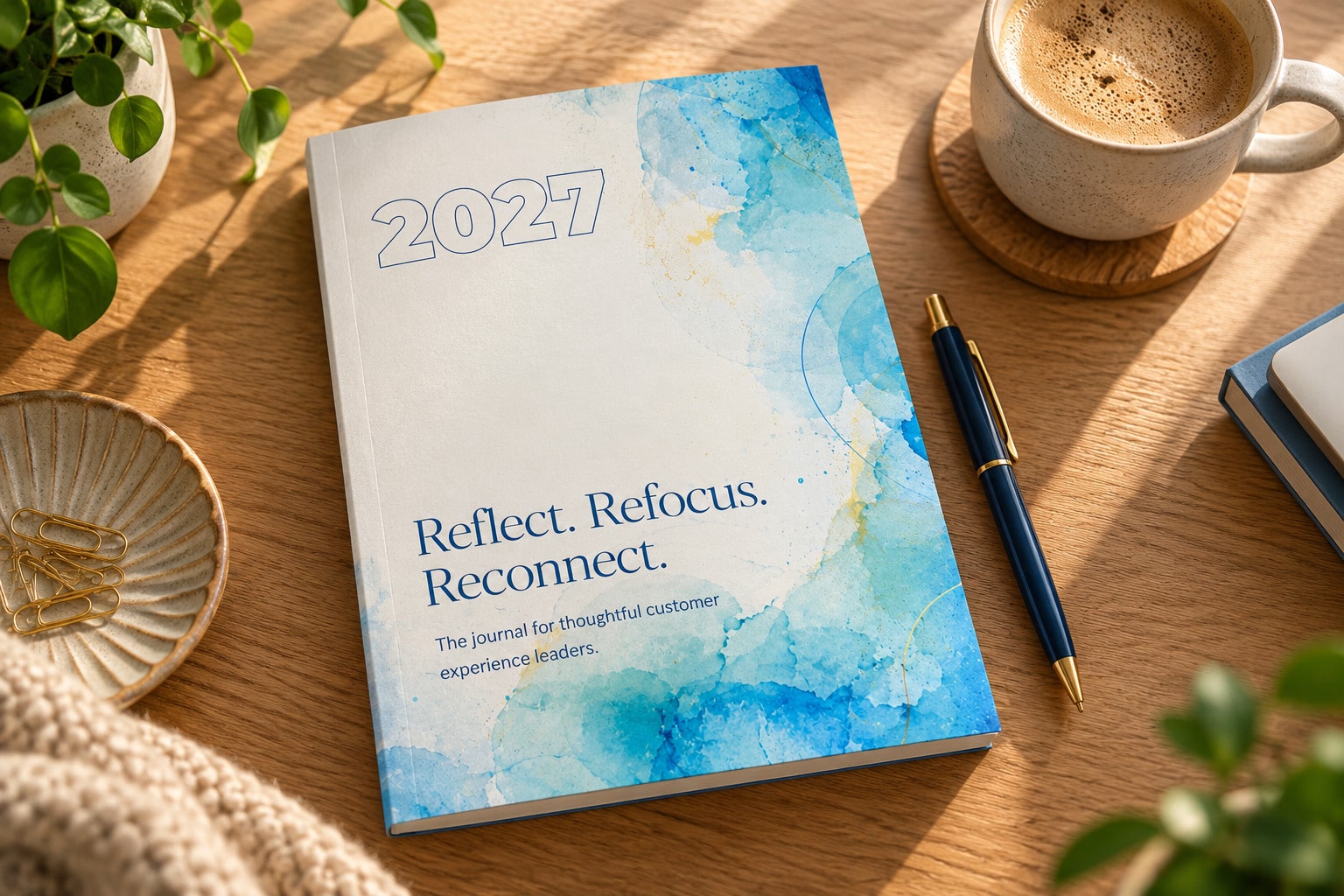
My 2027 journal, Reflect. Refocus. Reconnect., is the version I’ve been developing and refining since 2017. It began as the journal I needed for myself, but it has grown into a reflection tool for CX professionals and leaders who want a more intentional way to think about their work, customers, conversations and priorities.
It includes monthly themes, weekly planning and reflection pages, space to review customer observations, people, and conversations, and room to capture the things that don’t yet fit into a plan or report. It is structured enough to give you a rhythm for reflection, but open enough to hold whatever else is going on in your life and work.
My aim was to create a journal that feels practical and professional, while still leaving room for real thinking.
Key takeaways
- Keep a place for observations that do not fit anywhere yet. Reflection in customer experience often starts as a comment, a pattern, a tension or a question. If there is nowhere to capture it, it is easy to lose.
- Do not jump from information straight to action. Before deciding what to do, make time to ask what is actually going on.
- Reflect with evidence in front of you. Use customer comments, data, colleague observations and notes from visits or conversations. Reflection is stronger when it has something real to work with.
- Look at what is working, not only what is broken. Complaints and low scores matter, but so do moments when colleagues, stores, or processes are working well.
- Return to old notes. Some observations only make sense later. Reading back helps you see which ideas still matter, which patterns repeat, and which questions haven’t gone away.
If this episode resonated with you, I’d love to hear your thoughts. What’s one insight you’re planning to put into practice or one learning you took from today’s episode?
Let’s connect – Find me on LinkedIn (https://www.linkedin.com/in/jo-williams-ccxp/)
Never miss an episode – please subscribe to Where’s Your Customer? wherever you get your podcasts and get fresh customer experience insights in your ears weekly.
Found this valuable? Please leave me a review. It helps other retail professionals discover these conversations and honestly means the world to me.
Share the knowledge – If someone in your network could benefit from the ideas we’ve talked about today, please share this episode with them.


