





Table of Contents
When you walk into a retail environment that just works, what do you notice? It’s not the product range or the layout. It’s harder to name than that. Maybe it’s that the experience feels alive. It’s responsive. Adaptive. Like the people behind it had permission to think about it thoroughly.
The opposite is just as recognisable. Where experiences are still ok, but feel more mechanical. Every interaction follows a script, and every touchpoint is a process. The experience is consistent, but it doesn’t feel personal.
I’ve been thinking about what actually separates these two scenarios. It might be that playful retail teams create a condition for good experience design to flourish.
The Moment the Room Relaxes
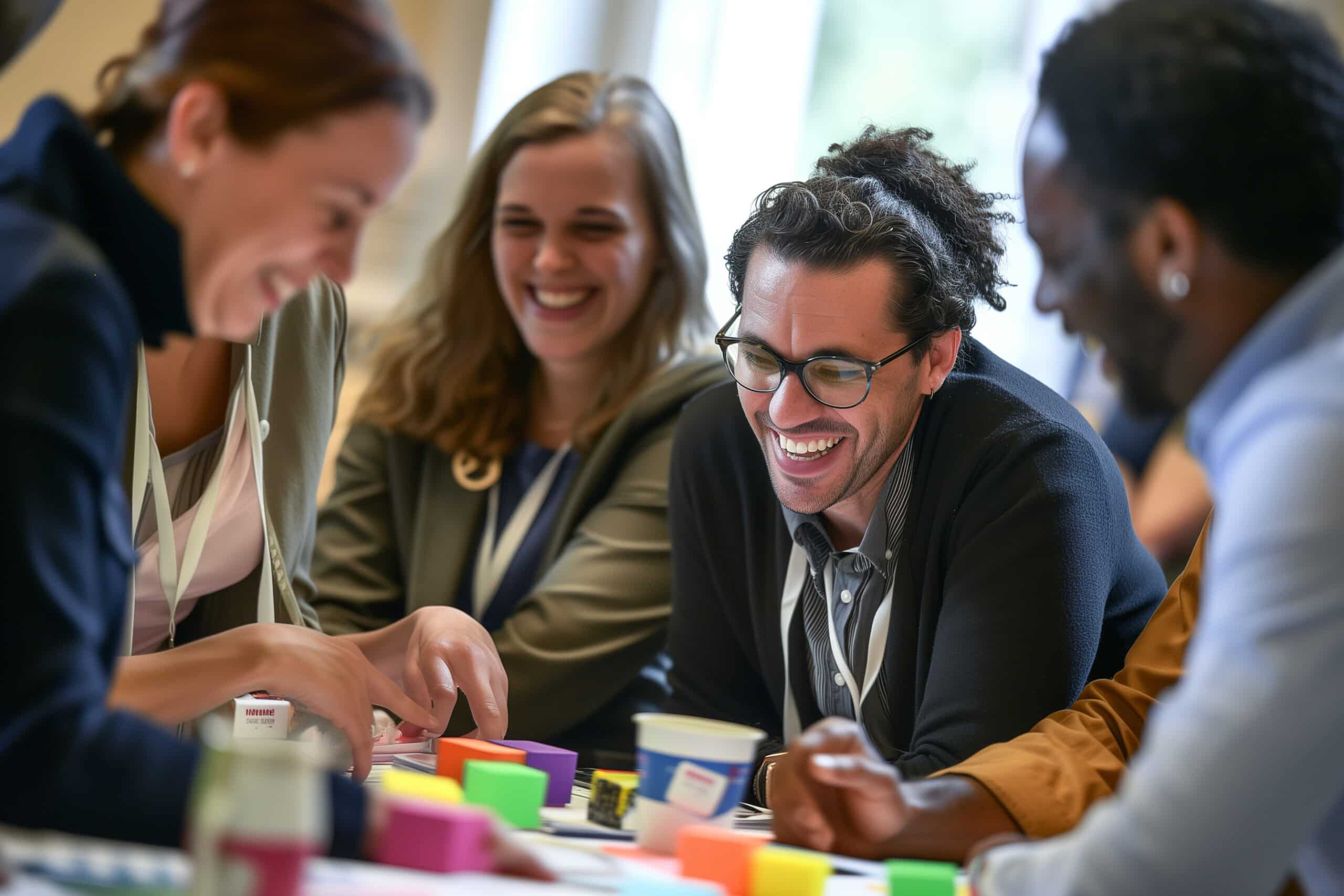
I noticed it during a session where we were stuck on how to improve a part of the customer experience. Someone suggested we map out the worst possible journey instead. Deliberately terrible. What would make someone never come back?
People laughed. Started describing absurd scenarios. But within ten minutes, we’d surfaced some useful insights that hadn’t come up in the serious part of the discussion.
The laughter wasn’t a distraction from the work. It unlocked better thinking.
And I keep wondering whether what we see in the experience is really a reflection of what’s happening inside the team.
What Playful Retail Teams Actually Look Like in Practice
Richer Sounds and John Lewis are two of the most consistent high performers in UK customer satisfaction surveys, and they share something beyond product range or pricing: both are built around employee ownership. John Lewis has been employee-owned since 1929. Richer Sounds transferred 60% of ownership to employees in 2019.
Employee ownership isn’t the only route to this. But it’s interesting that when people have a solid stake in the outcome, the experience customers receive tends to feel different.
You also see it in how some retailers approach the physical experience itself.
Lego’s Leicester Square flagship has become a place where storytelling replaces selling. One of their most recent experiences landed a spaceship inside the store, not a display, but something you board. You meet brick-built astronauts and aliens, build rockets at guided creativity tables, and then explore a digital theatre using NASA footage. Earlier, they transformed their Battersea Power Station space into ‘Le Florist’; an entire flower shop constructed from Lego bricks, 220 sets arranged into bouquets and displays.
Martin Urrutia, Lego’s head of retail experience, has described their approach as ‘storytelling spaces.’ Not selling spaces. Storytelling spaces. That’s a meaningful distinction.
Hamleys at Westfield London (a business founded in 1760) operates on the same principle. Team members demonstrating toys throughout the store. Playing with children. Creating theatre rather than processing transactions. They’re not competing on product or price. They’re competing on whether your child had an unforgettable afternoon.
Selfridges’ Sportopia campaign in 2024 took this even further. They built a 40-foot climbing wall, a rooftop Wimbledon viewing area, an Olympic swimming pool experience, an Aston Martin racing simulator, and enabled football kits to be tried on via augmented reality. They also created PlayHouse, a permanent gaming destination where adults who’d never picked up a controller could try VR alongside retro arcade games. Sixty-two per cent of UK adults played video games in 2020, many for the first time during lockdown. Selfridges noticed that, and created space for it.
And then there are smaller moves like Jellycat pop-up experiences, Converse stores where customers customise trainers with local artists, and Uniqlo’s Re-Uniqlo studios, where they mend and remake clothes rather than just selling new ones.
These aren’t random acts of entertainment. They’re examples of retailers giving their teams permission to ask what would make this moment more interesting.
The Strategic Case for Playful Retail Teams
Greg McKeown, in his book Essentialism, argues that play isn’t a luxury. He treats it as a strategic advantage and one of the highest-return activities for clarity, creativity, and decision-making.
His core argument is that when we play, we loosen rigid thinking. We see alternatives. We explore without fear of being wrong. And you can’t see better options when your brain is locked into survival mode.
Without play, people become reactive. Tired. Short-term focused. They stop thinking and start processing.
Research supports the mechanism. A study published in the Journal of Research in Personality examined ‘playful work design’. That is, allowing people to design small experiments into how they work, try new approaches, test ideas, and play with the edges of their roles. It found that this is associated with higher engagement and creativity.
It’s not about making work superficially fun. It’s about creating permission structures. ‘We’re allowed to try things that might not work.’ That mindset is critical to experience design because customer experience is inherently experimental. You can’t improve what you haven’t been allowed to explore.
Separate research from Harvard Business School on psychological safety (the shared belief that it’s safe to take interpersonal risks) shows it’s associated with team learning behaviour, and that learning mediates performance. In other words, the conditions that allow people to speak up, experiment, and admit uncertainty are the same conditions that allow teams to adapt.
Why Retail Pressure Is Squeezing Out the Conditions for Good CX
Retail is under real pressure right now. Crime. Safety incidents. Workforce strain. Margins tightening.
The British Retail Consortium’s 2025 Crime Survey documents violence, abuse, and theft at record levels, with significant investment in prevention and a rise in weapon-related incidents. That’s not abstract background noise. That’s the shop floor reality retail teams operate in every day.
All of that creates a kind of survival mode. Tight control. Risk avoidance. Processes that protect consistency.
Standardisation isn’t the wrong answer. Customers need reliability, and consistency protects trust. But there’s a difference between reliability and rigidity.
When teams shift into pure survival mode, with no room to deviate and no permission to adapt, the experience becomes brittle. Not broken. Just a bit flat. Because the people delivering it lack the discretion to respond naturally to what’s happening in front of them.
They’re following the process.
Which works fine for routine transactions. But it falls apart the moment something unexpected happens.
What Customers Feel (And Why It Matters)
Customers notice the difference. Maybe not consciously. But there’s a felt quality to interacting with someone who’s thinking versus someone who’s processing.
It shows up in small moments. The person who suggests an alternative when something’s out of stock. The team member who adapts their explanation based on what you actually need to know. The store that feels like the people working there have room to care about outcomes, not just complete tasks.
These aren’t grand gestures. They’re micro-signals of discretion.
Timpson is a useful example of this done well. In episode 10, we used Timpson as a case study for “pockets of brilliance” in customer service and focused on their unique business model. Their frontline teams are given significant discretion to solve problems on the spot, like refunds, repairs, and fixes that technically fall outside policy. The expectation isn’t ‘protect the rules.’ It’s: use your judgement.
Customers don’t walk away thinking about the policy framework that allowed that decision. They remember the moment someone took ownership and made their day easier. That’s what discretion looks like in practice. And it only exists where teams are trusted to think.
The Question of What We’re Optimising Out
Retail has spent two decades getting very good at optimisation. Processes. Systems. Metrics. Control. That’s produced real gains.
But I suspect we may be optimising out the very thing that produces the experiences customers value most. The humanity. The adaptability. The sense that someone is thinking about your specific situation rather than just going through a routine.
You can make retail efficient by standardising everything. But the human moments, the ones customers actually remember, require someone to have space to think. Permission to deviate when it makes sense. Trust that they won’t be penalised for trying something and getting it slightly wrong.
Permission isn’t experienced as a policy. It’s experienced as micro-signals.
Can I deviate from the script to solve a customer problem? Will I be backed if I try something and it fails? Do we have time to reflect and learn?
Those are the questions people are asking themselves in real time. And the answers shape what becomes possible.
When workload and risk rise, humour and curiosity disappear first. Stress narrows thinking. When people feel exposed (judged, rushed, or unsafe), their brain shifts into protection mode. The goal stops being exploration. It becomes survival.
And survival thinking is efficient. But it’s not imaginative.
Exhausted teams don’t design generous experiences. They design efficient ones.
Playful Retail Teams Might Be the Result, Not the Cause
I want to be honest that this isn’t simple.
Play could be a luxury signal. Better-performing retailers might earn the slack (the teams, the time, the breathing room) that allows it. It’s possible, then, that play is a lag indicator rather than a lead indicator. The result of success, not the cause of it.
That’s worth acknowledging. But even if that’s true, leaders still need to notice what stops play: Threat. Overload. Punitive controls.
If play is the first thing to disappear under pressure, that tells you something important about the conditions you’re creating, and what those conditions are doing to your team’s capacity to adapt.
There’s also a research signal worth including here. A study in the Journal of Business and Psychology on what they call the bright and dark sides of playful work design found that competition-style play can raise engagement but may also increase workaholic tendencies. The balance between fun and competitive pressure matters. Leaders can’t simply mandate ‘be playful’ without shaping the norms and managing the load.
This argues for bounded play (safe experiments, clear purpose) rather than no play at all.
Frequently Asked Questions
Does play actually improve performance at work?
Research suggests it can, specifically when it takes the form of intentional small experiments and varied approaches to how work gets done. The Journal of Research in Personality’s 2019 diary study found associations between daily playful work design and both engagement and creativity. The effect depends on context and fit, but the mechanism is credible: play loosens rigid thinking and enables people to see alternatives they wouldn’t otherwise spot.
How does team culture affect customer experience?
Directly, though, the link is often invisible from the outside. The conditions a team operates in (whether they have permission to adapt, whether they feel psychologically safe to try things and admit uncertainty) shape what kind of service is possible. A team in survival mode can deliver consistency. But it struggles with the edge cases, service recovery moments, and human interactions that customers actually remember.
Can playfulness exist in high-pressure retail environments?
High-pressure contexts, such as rising crime, workforce strain, and tightening margins, are more likely to create conditions that narrow thinking and increase defensive behaviour. Play may genuinely be harder to sustain in these environments. But leaders who notice what’s preventing play, rather than just what’s killing margin, are making a different kind of decision about the experience they can produce.
How do leaders create space for experimentation?
The smallest unit of change isn’t a programme or a workshop. It’s what happens when someone tries a new idea. Do they get backed or blamed? That single signal, repeated across hundreds of small moments, tells people more about whether experimentation is welcome than any policy document ever will.
Why do some stores feel more alive than others?
Usually, because the people in them have room to care about outcomes rather than just tasks. There’s discretion. There’s curiosity. There’s something at stake beyond executing the process correctly. That’s not magic. It’s a set of conditions that either exist or don’t, shaped by leaders’ decisions about control, trust, and what gets rewarded.
What This Leaves Open
I keep coming back to that moment in the session. The room relaxing. Laughter. Better ideas surfacing.
And I find myself wondering whether the quality of customer experience is directly linked to whether teams feel allowed to enjoy the act of designing it. Not ‘enjoy’ in a frivolous sense. Enjoy in the sense of having room to think. To play with possibilities. To explore alternatives without fear.
Because play is where surprise lives. Where delight lives. Where humanity lives.
And customer experience without humanity is just process.
So instead of asking ourselves, ‘How do we make our experience better?’
Maybe we need to consider the conditions we create that allow people to think clearly about what could be better.
And then, are we protecting those conditions, or optimising them out?
If this episode resonated with you, I’d love to hear your thoughts. What’s one insight you’re planning to put into practice or one learning you took from today’s episode?
Let’s connect – Find me on LinkedIn
Never miss an episode – Please subscribe to Where’s Your Customer? wherever you get your podcasts, and get fresh customer experience insights weekly.
Found this valuable? I’d love it if you could leave me a review. It helps other retail professionals discover these conversations, and it would mean the world to me.
Share the knowledge – If someone in your network could benefit from the ideas we’ve talked about today, please share this episode with them.


