





Table of Contents
A few weeks ago I was talking to Matt, my other half, about HMV. He’s a film fan, classic films especially, and he knows a lot about the shop: what it used to stock, how it has changed, who goes in now. He was so enthusiastic about it that I started thinking about the role of the store, and whether there might be an episode in it. So I went digging.
I asked him why he used to go. He said it was the choice. The range was big enough that you could pretty much guarantee they’d have what you were looking for, and it was sorted into sections, so you could lose hours in there. He described it as a place for film fans.
That got me thinking about HMV more generally.
HMV has been part of the UK high street for over a hundred years. For a long time I assumed it was the kind of retailer that should have disappeared by now. Music is streamed now, and so are films. If you want a specific copy of something, you can usually find it and get it faster online.
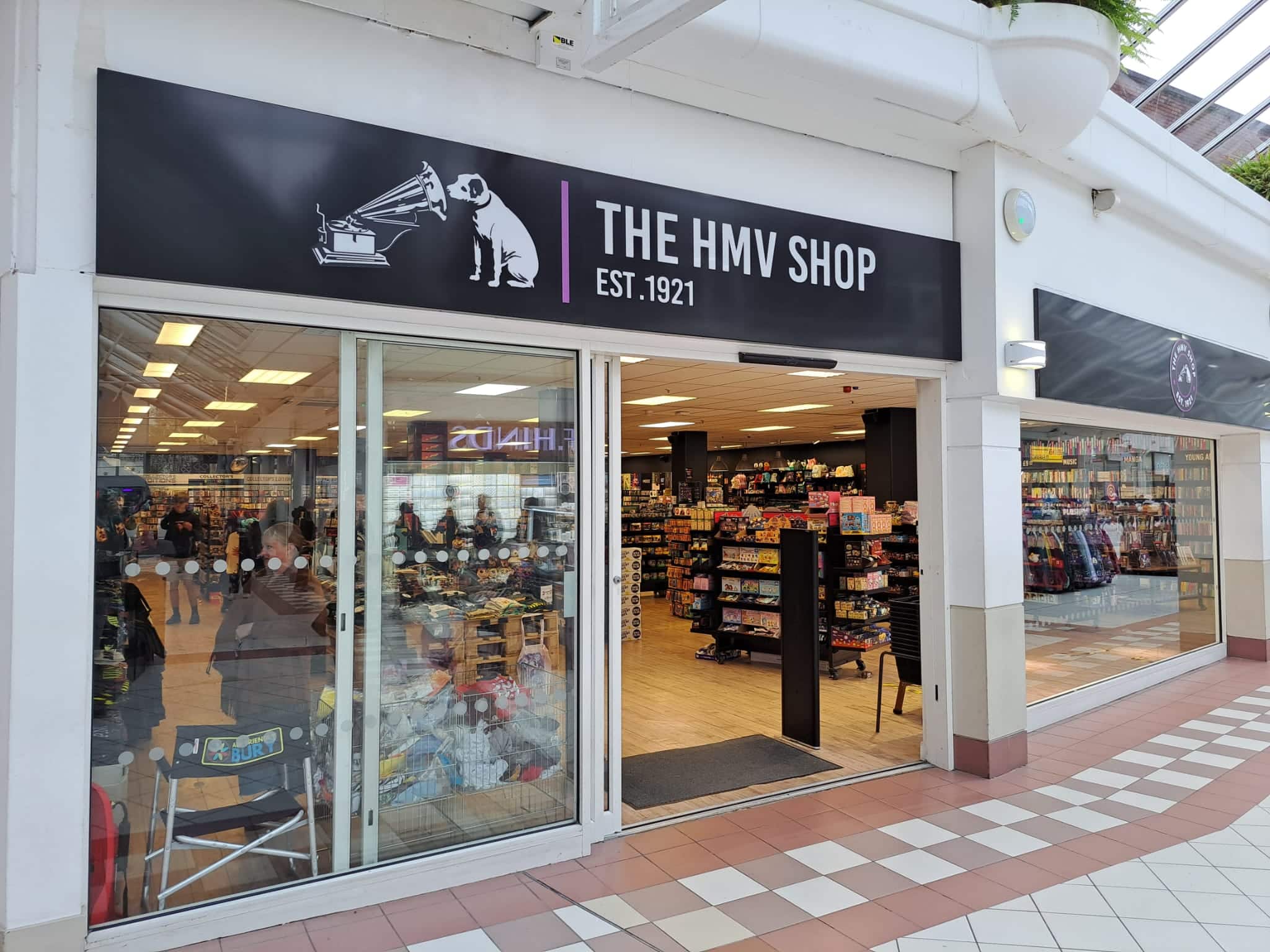
And yet HMV is still there, with more than 100 shops in the UK, and it says more people are visiting them. In the first half of 2026, it reported footfall up 12% (Retail Gazette), at a time when most music is streamed, and Amazon sells almost every film and album.
So why do people still shop at HMV? And what does that tell us about the role of the store in retail more widely?
People go in for two different things. Some want a copy of something specific. Others want to spend an hour looking. Amazon can do the first. It’s less good at the second.
What the old HMV did for customers
I wasn’t a huge HMV shopper. But I did enjoy going in. This was the late nineties, when I was at university. I love dance music, and most other genres too, and they always had music playing, so the shop sounded like a party. I’d go in looking for the latest mix album and end up browsing the whole library of artists. I knew that if I wanted the latest tunes, they’d have them.
Occasionally I’d buy an album, for my own collection or as a gift. If you were buying someone a present, or you’d been given a voucher, that meant a trip to the shop. Buying music online wasn’t something most of us did yet.
Matt remembers the big HMV in Manchester, opposite the Arndale Centre, around 1993. It had a basement of vinyl, a ground floor of CDs and a first floor of films. He says it felt like a supermarket of VHS tapes.
In 2009, HMV’s shops took 28% of all the money spent on recorded music in the UK, and its website took another 3.6% (Music Week, January 2011). At its peak, it ran 285 stores across the UK and Ireland (AccountingWEB).
So the old HMV was doing several things for customers at once. It had the range, so you could find almost anything. It organised that range so you could find what you wanted. It was somewhere for people who were really into music or film. You could immerse yourself in it. And it was where you went to buy a present.
Those are the jobs customers came to the shop to get done. As people found other ways to get some of them done, the role of the store had to change. Working out what HMV’s shops are for now is the same question facing most retailers with a store estate.
What moved elsewhere
In January 2013, HMV went into administration (Netimperative). At the time, it was blamed on competition from supermarkets and online retailers, made worse by people downloading music and films.
Supermarkets took the chart titles, often selling them cheaply to get people through the door. Amazon took range and price. In 2013, a journalist found a Clint Eastwood box set priced at £110 in HMV and £50 on Amazon (ITPro, January 2013). That’s one example from one journalist, but it tells you what customers were seeing.
Downloads, then streaming, took access. If you only want to hear an album or watch a film, you don’t need to own it any more.
By 2014, Amazon was the biggest entertainment retailer in the UK, with 21.8% of the market. HMV was second, at 14.7% (Kantar, via Pollstar).
There’s a line from HMV’s boss at the time. When told that supermarkets, downloads and online retailers were the big threats, he said supermarkets weren’t a threat to “the serious music, games or film buyer”. He was drawing a distinction between someone picking up a chart album with their weekly shop and a fan after a particular film. HMV’s range gave that fan a reason to visit.
Online retailers offered the range too, and an easier way to check what was available. Being a keen film fan stopped being a reason to visit on its own.
Which is where Matt is now. He still buys from HMV, but more often than not he goes to Amazon first. He calls it “an information service”. He checks whether a film is in print, then decides: buy it now if he wants it quickly, or make a mental note for his next trip to HMV or Fopp. He buys new releases and presents on Amazon because he knows he’ll get them. What he buys in the shop is mostly what he spots while he’s in there.
He has never used HMV’s website. He didn’t have an answer for why.
So Matt uses Amazon to answer the first question in a purchase, which is whether the thing is available, and the shop for a different part of the journey. That split is worth looking at, because it’s where the role of the store gets settled. If a customer’s first question is answered elsewhere, the shop has to be good at what they want next.
Four checks show whether a shop can hold on to that step. Can a colleague see whether a title is in print and whether it’s in stock? Can they order it at the till in under a minute? Can they say when it will arrive? And does the store get credit for the sale in its reporting? Retailers comparing online shopping and in-store shopping usually look at where customers buy. Where they go to find out matters as much.
What stayed
The first thing that stayed is owning a copy of what you care about.
Matt loves Humphrey Bogart films. They aren’t on Netflix, Paramount+ or Apple TV. Streaming catalogues are wide, but titles rotate, so you can’t rely on a particular film being there when you want to watch it.
HMV’s managing director, Phil Halliday, said in March that DVD and Blu-ray sales were growing again, linking it to the cost and complexity of streaming. Films are spread across more services, so finding one can mean checking several, and subscription prices have gone up (Phil Halliday, Press Association, March 2026, company-reported).
Those are HMV’s own numbers. Across the market, physical music and film are moving in different directions. Physical music rose 11.5% in 2025, led by vinyl, which was up 18.5% (ERA). Physical film fell 4.7% to £148.9 million, the slowest decline since 2010 (ERA, via Senal News). Blu-ray, including 4K, now outsells DVD. Sales of 4K discs grew 19.5%, and steelbook special editions took close to £2 of every £10 spent on 4K (BASE, via Film Daily).
Both things can be true at once. HMV can grow its own film sales while the total market falls, because the growth sits in the editions collectors pay more for.
Matt buys those from Fopp, which HMV owns and which has six UK shops (Fopp). Fopp stocks more of the prestige labels he follows, including Indicator, Eureka and the Criterion Collection. HMV stocks fewer of them. For a retailer with a demanding customer base, keeping a small number of specialist shops with real depth protects the role of the store better than spreading a thinner range across the whole estate.
The second thing that stayed is browsing, and it’s the part of the role of the store that hasn’t moved at all.
When I asked Matt whether HMV is still one of his favourite places to go, he said yes. He said HMV and Waterstones let you immerse yourself in something, and they prompt you to buy things you wouldn’t if you shopped online.
Choosing what goes on the shelves is a customer experience decision. With limited space, someone has to decide which customers the shop is for. For Matt, a good choice of the film labels he follows makes the trip worth making. For someone else, it might be the latest music releases.
What’s new
This is the part I didn’t have when I started thinking about the episode.
Matt went into HMV on a Saturday in late October and paid attention to who was there. He counted four groups: young people browsing a bit of everything, children under 10 looking at Funko Pop figures with a parent nearby, older couples where one browsed and the other waited, and the biggest group, middle-aged film and music fans, mostly on their own, looking through the films, CDs and classic vinyl.
The shop had a sign saying “pop culture”, a Blu-ray section labelled “superheroes”, books, graphic novels, branded clothing and posters. Quite a change from the HMV he remembered, where an entire floor had been devoted to films.
That’s one shop on one day, and one customer’s account. It does line up with what HMV says, though. It says footfall rose 12% in the first half of this year, and that Saturdays, which used to be slow, are now busy, mainly because of younger customers coming in for K-pop CDs, trading cards and collectables, and to meet friends (The Scotsman).
So the role of the store now covers more ground than it used to. The same shop has to serve several roles. Someone might need help finding a particular edition of a classic film, and a few minutes later a colleague is answering a question about a K-pop release. That takes product knowledge, a range that reflects who is coming in, and enough people on the shop floor to help.
Retailers looking at community space in retail are asking themselves something similar: whether people come to buy, to meet, or both.
The question I’d want HMV to think about is what brings younger customers back. Their interests will move on, and trends move on faster. Knowing what they enjoy about the visit, beyond the collectable they came in for, tells you how to keep the role of the store relevant to them.
Keeping the role of the store affordable
There’s a commercial side to all of this, and it’s where most of these decisions actually get made.
HMV went into administration twice, in 2013 and 2018 (Netimperative; Reuters). Even at the second collapse, it sold nearly a third of the UK’s physical music. A large share of a shrinking market wasn’t enough to keep the business going (AccountingWEB).
When Doug Putman bought it in 2019, he kept 100 of its 127 shops, closed the rest, and renegotiated rents (Billboard; Raconteur).
Rent still decides where HMV trades. It will leave its Oxford Street shop, the site of its first store in 1921, in March 2027, after the landlord proposed doubling the rent, despite like-for-like sales being up 15% in the first nine months of 2026 (ITV News).
Those decisions reach the customer. A closure changes how far someone has to travel. Less space means a smaller range, and the range is where customers decide whether the trip is worth making. When a shop gets smaller, the first question is which customers it exists for. If it’s the collector, protect the depth in the categories they buy and use ordering to cover the rest. If it’s the younger browser, protect the space and the things that make it somewhere to go. Cutting evenly across the range usually weakens both. The case for what a store is worth beyond its sales depends on making that choice deliberately.
How to work out the role of your store
Most store reporting tells you what was sold. It won’t show you the visit where a customer browsed, checked a title with a colleague and ordered it for collection next week. That visit can look like a lost sale in the figures and still be the reason the customer comes back.
Figuring out the store’s role starts with talking to customers about specific occasions. Here’s what I’d do.
Start with one type of customer and a few recent occasions when they needed something your business could help with. Include the occasions when they chose somebody else.
Ask them to talk you through what happened. What prompted them to act? What did they need? Why that shop or that website? Try to get past “they wanted a good range”. Were they trying to find a specific edition, choose a present they felt confident about, or discover something new? Each of those is a different experience to design.
Then look at the role you played. Where did they look for information, get advice, make the choice and pay? They may have used several businesses along the way. Compare that with what customers used to rely on you for. Which needs are you still serving? Where did someone else do it better? Has anyone started using you for something you hadn’t expected?
Then pick one thing to improve. Take a customer need you want to serve well and look at what gets in the way: availability, information, range, staff knowledge. Bring the people who own those decisions into the discussion. Agree what will change, who will act and when you’ll review it. Choose a measure that reflects what the customer was trying to achieve. If they wanted a particular item, could they get it when they needed it? If they wanted help choosing a gift, did they leave confident in their choice?
The people who set the range, the rota and the reporting decide the role of the store, so they need the customer evidence in front of them before they decide.
Key takeaways
- People still shop at HMV for two reasons: they want a copy of something specific, or they want to spend time looking. Amazon handles the first, and the shop wins the second.
- Most of what HMV used to do for customers moved to supermarkets, Amazon and streaming. What stayed is owning a copy of something you care about, and browsing a range deep enough to surprise you.
- The range decides the store’s role, and it’s usually set by cost. When a shop gets smaller, choose which customer it exists for rather than cutting evenly across everything.
- Younger customers have added a reason to visit that has nothing to do with the product. Knowing what they enjoy about the visit, beyond the item they came for, is what keeps them coming back.
- To figure out what your store is for, pick one customer type and a few recent occasions, including the ones where they went elsewhere. Ask what they were trying to achieve, look at where you fit in, fix one thing, and set a date to review it.
Let’s connect – Find me on LinkedIn (https://www.linkedin.com/in/jo-williams-ccxp/)
Never miss an episode – please subscribe to Where’s Your Customer? wherever you get your podcasts and get fresh customer experience insights in your ears weekly.
Found this valuable? Please leave me a review. It helps other retail professionals discover these conversations and honestly means the world to me.
Share the knowledge – If someone in your network could benefit from the ideas we’ve talked about today, please share this episode with them.


